Category: Uncategorized

  • Naver Map vs Google Maps in Korea: Why You Need Both

    Naver Map vs Google Maps in Korea: Why You Need Both

    Here’s the mistake every first-time visitor makes in their first hour: they open Google Maps, type a cafe name, hit “Directions,” and get… nothing useful. A dotted line. A shrug in app form. Then they wonder if their phone is broken.

    Your phone is fine. Google Maps is genuinely, structurally limited in Korea — and once you know why, the fix is easy.

    Why Google Maps doesn’t fully work here
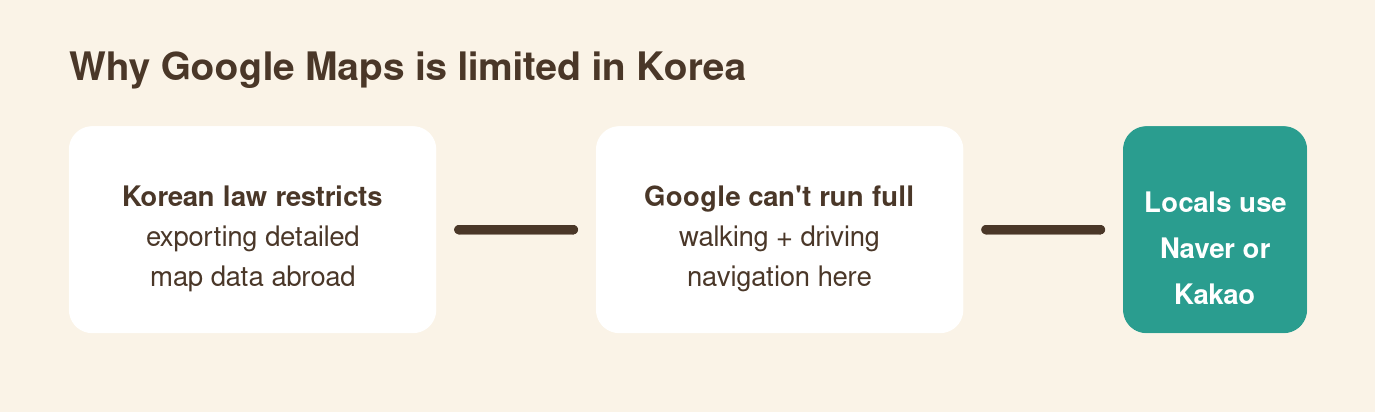
    Diagram explaining Korean map data export law limits Google Maps navigation, locals use Naver or Kakao

    Korean law restricts exporting detailed government map data to servers outside the country. Google processes its maps abroad, so it never got the full dataset. The result: in Korea, Google Maps can’t do turn-by-turn driving navigation and its walking directions range from “vague” to “confidently wrong.”

    The one thing Google Maps does well here: public transit. Subway and bus routing works, and for that it’s honestly excellent.

    What locals actually use

    Naver Map (네이버 지도) — and its rival Kakao Map — run on the full domestic data. Naver Map has a proper English mode, which is why it’s my recommendation for visitors over Kakao (whose English support is thinner).
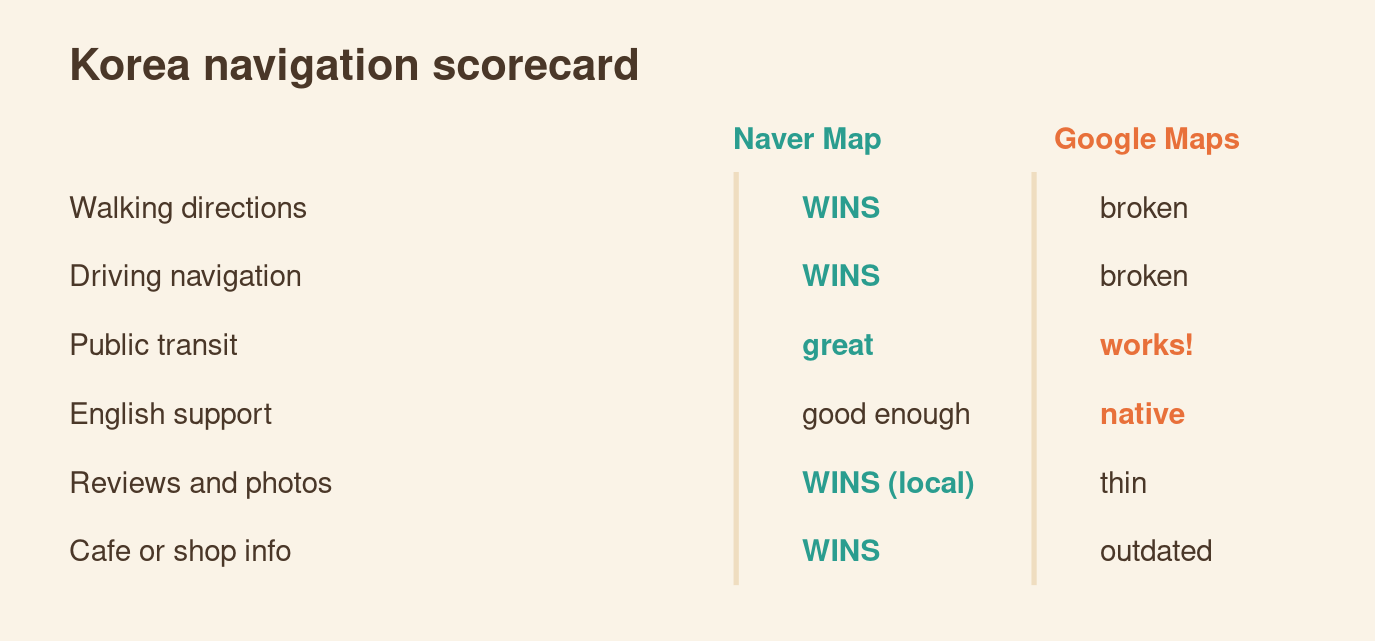
    Scorecard comparing Naver Map and Google Maps in Korea across walking, driving, transit, English support and reviews

    Naver Map gets you: accurate walking routes (including which subway exit to take — this matters, some stations have 14), real-time bus arrivals, driving navigation, and the local review ecosystem. Korean reviews and photos on Naver are the closest thing to ground truth about whether a restaurant is actually good.

    The two-app workflow

    Don’t pick a side. Use both for what they’re good at:

    • Search and discovery in Google Maps — English search is more forgiving, and tourist spots have English reviews.
    • Actual navigation in Naver Map — once you know where you’re going, Naver gets you there. Copy the place name (or the Korean name from Google’s listing) and paste it into Naver.
    • Transit in either — both route subways well; Naver adds better bus data.

    Naver Map setup tips (2 minutes)

    • Download “Naver Map” — the global version has English built in. Switch language in settings if it opens in Korean.
    • No Korean account needed for navigation. You only need to log in for saving favorite places.
    • Learn the exit-number habit: when Naver says “Gangnam Station Exit 11,” it’s not a suggestion. Coming out of the wrong exit at a major station can mean a 10-minute underground hike back.
    • Star your hotel on day one. Future-you, lost at midnight, will be grateful.

    Bottom line

    Google Maps in Korea is a search engine, not a navigator. Install Naver Map before you land, run them side by side, and you’ll move through Seoul like you’ve been here before. Total cost: two minutes and 80 MB.

  • Why Koreans Eat Seaweed Soup on Birthdays (It’s About Mom)

    Why Koreans Eat Seaweed Soup on Birthdays (It’s About Mom)

    Ask a Korean friend what they ate on their birthday and the answer usually isn’t cake. It’s a bowl of seaweed soup — miyeokguk (미역국). Warm, briny, deeply savory, and about as far from a party food as you can imagine. There’s a reason, and it’s one of my favorite pieces of Korean culture to explain, because it’s really a story about mothers.

    It starts in the delivery room

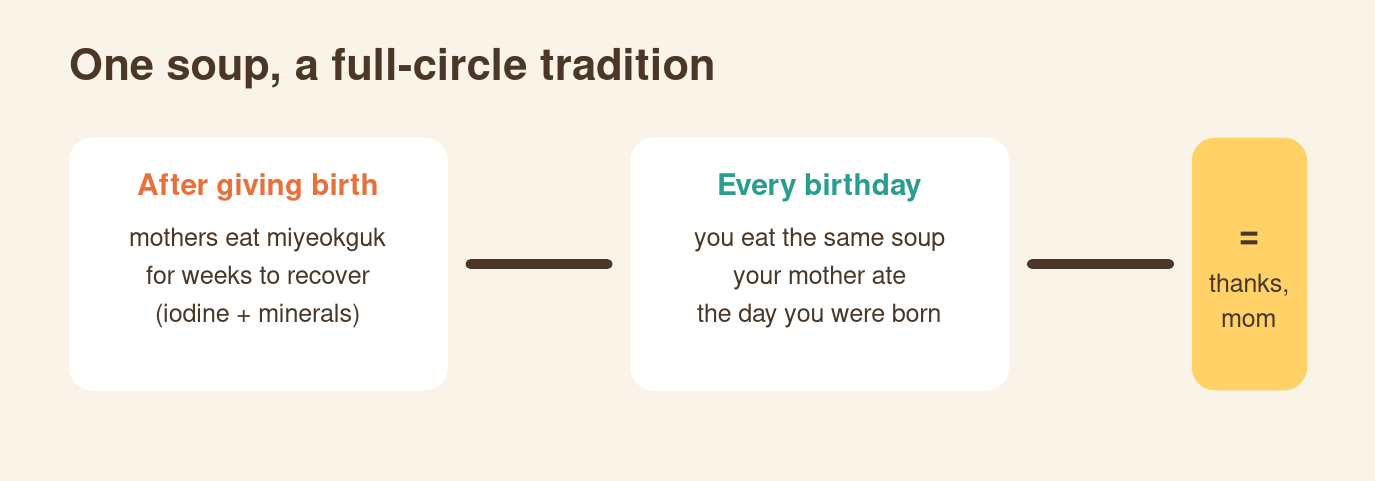
    For generations, the first meal a Korean mother eats after giving birth is miyeokguk. Not as ceremony — as recovery. Seaweed is rich in iodine, calcium, and minerals, exactly what a postpartum body needs, and new mothers traditionally eat it every day for weeks. Hospitals in Korea still serve it to new moms today.

    Diagram showing the Korean tradition: mothers eat seaweed soup after birth, children eat it on birthdays as gratitude

    So when you eat miyeokguk on your birthday, you’re eating the same soup your mother ate the day you were born. The birthday bowl isn’t really about you — it’s a quiet annual nod to the person who did the hard work that day. I’ve heard it described as “the most understated thank-you card in the world,” which is about right.

    What it actually tastes like

    If you’ve never had it: silky ribbons of wakame seaweed in a broth usually built on beef, mussels, or dried anchovy. It’s savory in that deep, oceanic way — the textbook definition of umami (we’re contractually obligated to love that word around here). Koreans eat it over rice, often with the rice dumped straight into the bowl. Breakfast miyeokguk on your birthday morning, made by your mom, is the canonical experience.

    The exam-day taboo

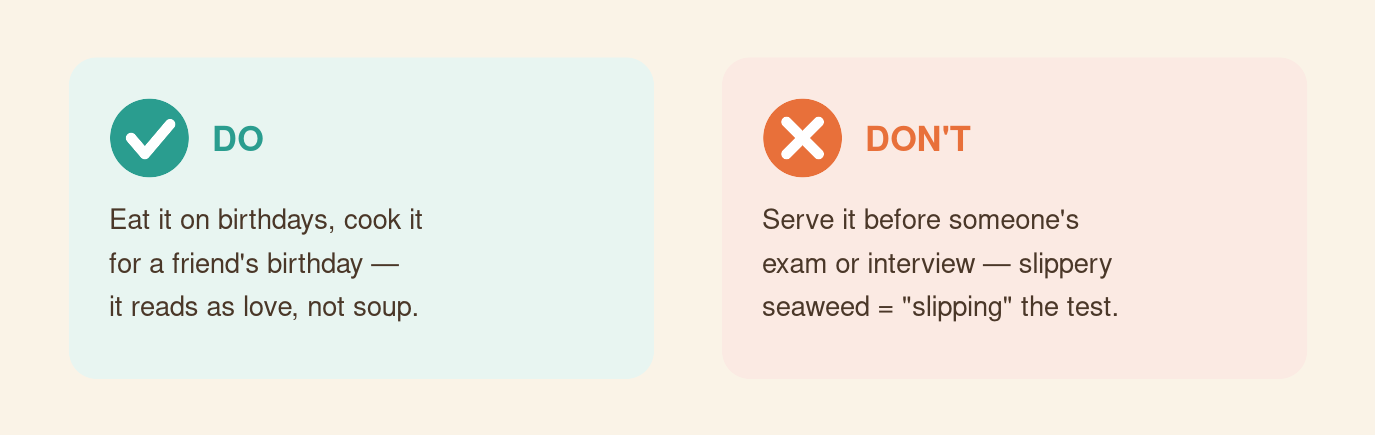
    Here’s where it gets fun. The same soup is bad luck before a test. Seaweed is slippery — and in Korean, “slipping” (미끄러지다) is exactly the word used for failing an exam. So no miyeokguk before the big test, the job interview, the driving exam. Superstition? Sure. Will a Korean mother still quietly not serve it the morning of the college entrance exam? Absolutely.

    Do eat seaweed soup on birthdays, don't serve it before exams in Korea

    If you want to try it

    • Any gukbap or home-style restaurant will have it, usually 8,000–10,000 won with rice and side dishes.
    • Convenience stores sell instant miyeokguk — surprisingly decent for 2,000 won.
    • Cooking it is beginner-friendly: soak dried miyeok, sauté with sesame oil and beef, add water, simmer, soy-sauce-and-garlic to taste. It’s nearly impossible to ruin.

    Bottom line

    Miyeokguk is the rare dish that’s simultaneously a health food, a birthday ritual, and a love letter. If a Korean friend cooks it for your birthday, understand what’s being said: you mattered enough for the mom treatment. Eat the whole bowl.

  • How to Order Food Delivery in Korea (Without Reading Korean)

    How to Order Food Delivery in Korea (Without Reading Korean)

    Korea is the world capital of food delivery. Fried chicken at 2 AM, cold noodles in a heatwave, a single iced americano because you simply could not walk 200 meters — it all arrives, fast, at almost any hour. The catch: the apps were built for locals, and your foreign phone and foreign card can make day one frustrating.

    Here’s the setup that actually works, learned through more delivery orders than I care to admit.

    Pick the right app first

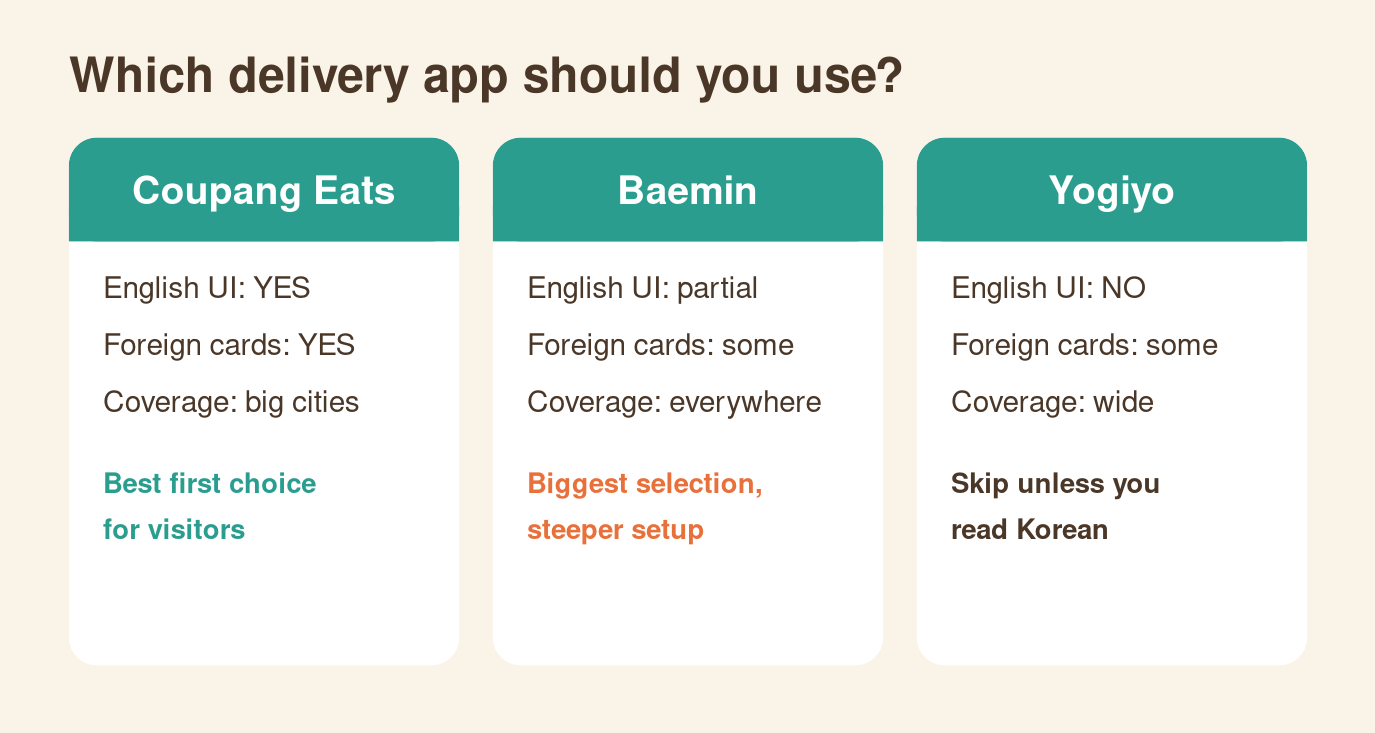
    There are three big players, and as a foreigner you should not treat them equally.

    Comparison of Korean delivery apps Coupang Eats, Baemin and Yogiyo for foreigners

    Start with Coupang Eats. It has a real English interface and takes foreign-issued cards without drama. That combination is rare and precious here.

    Baemin (배달의민족) is the giant — the most restaurants, the most everything — but English support is partial and foreign card acceptance is hit-or-miss. Graduate to it once you’re comfortable, or if you have a Korean card.

    Yogiyo is Korean-only. If you can’t read the menu, ordering blind is a gamble I don’t recommend beyond “point at the picture and pray.”

    The setup, step by step

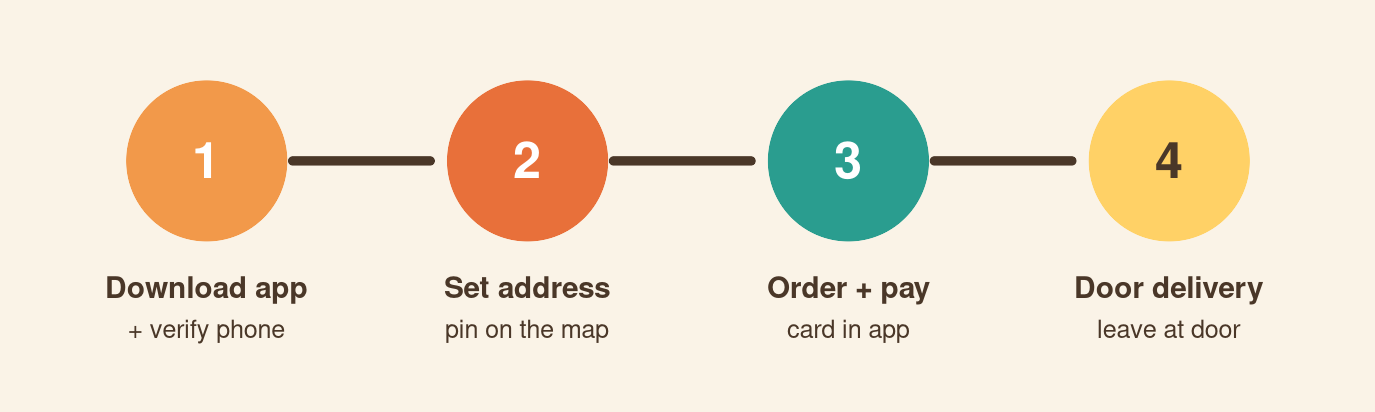
    Four steps to order delivery in Korea: download app, set address, order and pay, receive at door

    Step 1 — Download and verify. You’ll need a Korean phone number that can receive SMS. A tourist SIM or eSIM with a Korean number works; a foreign number mostly doesn’t.

    Step 2 — Set your address by pin. Korean addresses confuse everyone, including Koreans. Don’t type — drop the pin on the map, then add the building and unit number in the detail field. If you’re at a hotel, add your room number and the front desk usually handles the rest.

    Step 3 — Order and pay in-app. Register your card inside the app. If your card gets rejected (it happens with some foreign cards on Baemin), switch to Coupang Eats or choose “meet and pay by card” where available.

    Step 4 — The door knock that never comes. Korean delivery default is contactless: they leave it at the door, take a photo, and vanish. Check your app notifications, not your doorbell. The phrase you’ll see everywhere: 문 앞에 놔주세요 — “leave it at the door, please.”

    Things nobody tells you

    • Minimum order amounts are real. Most places want 12,000–20,000 won minimum. Yes, that’s why your single americano needs a cheesecake chaperone.
    • Delivery fees vary wildly — same restaurant, different fee depending on distance and time. Rain doubles everything, including the wait.
    • Chicken on Friday night is a war zone. Expect 60–90 minutes. Order early or embrace defeat.
    • Tipping doesn’t exist. The price is the price. Please don’t try; you’ll only confuse the rider.

    Bottom line

    Coupang Eats + a Korean number + pin-drop address = food at your door in 30 minutes, no Korean required. Set it up on your first day; your jet-lagged 1 AM self will thank you.

  • T-money Card in Korea: The Only Guide You Actually Need (2026)

    T-money Card in Korea: The Only Guide You Actually Need (2026)

    Here’s the first thing I hand any friend who visits me in Seoul: a T-money card. Not a restaurant list, not a palace map — a bus card. Because nothing ruins day one like fumbling with single-journey ticket machines while a line of commuters silently judges you.

    This little card is about 3,000 won of pure quality-of-life. Let me walk you through it the way I would if you’d just landed at Incheon and texted me “ok now what.”

    So what is it?

    T-money is Korea’s tap-everything card. Load cash on it, tap into the subway, tap onto a bus, tap out, done. The fare math happens automatically — including transfer discounts, which we’ll get to, because that’s where it quietly saves you real money.

    One card covers basically the whole country: Seoul, Busan, Daegu, Jeju. Buy it once, use it everywhere, keep it forever (it doesn’t expire — mine is older than some K-pop groups).

    Where to get one

    Any convenience store with a T-money logo on the door — CU, GS25, 7-Eleven, emart24. You cannot walk 200 meters in a Korean city without hitting one of these, so this will not be a quest. Cards run 2,500–4,000 won depending on how cute the design is. Yes, cuteness is a pricing factor here. Welcome to Korea.

    You can also grab one at Incheon Airport (the convenience stores in arrivals sell them) or from subway station vending machines, which have English menus.

    Heads up: the card comes empty. The price is just for the plastic. Charging it is a separate step, which brings us to the one genuinely annoying thing about T-money.

    Charging it: bring cash, seriously

    This is the part that catches everyone off guard: top-ups are cash-only almost everywhere. Korea is otherwise a card-tapping paradise — and then T-money recharges are stubbornly stuck in the cash era. Your foreign Visa will not help you at the recharge machine. I’ve watched many tourists learn this in real time.

    Two ways to charge:

    • Subway station machines — English menu, 1,000 won increments, painless.
    • Convenience store counter — hand over card and cash, say “chungjeon” (충전). The clerk taps some things, you’re done in ten seconds.

    Load 20,000 won to start. That’s a few days of normal sightseeing in Seoul.

    What rides cost (and the transfer trick)

    Subway base fare is around 1,550 won with T-money; buses are similar. But the real feature is the transfer discount: switch between bus and subway within 30 minutes and the second leg is free or heavily discounted.

    One habit to build: always tap out when leaving a bus. No tap-out, no transfer discount on your next ride. You’ll see locals do it automatically — copy them.

    It’s also a tiny wallet

    T-money works at convenience stores, most vending machines, taxis, and some cafes. This is the cheat code for the end of your trip: got 4,000 won stuck on the card? That’s a convenience store snack run, and your balance problem becomes a banana milk problem.

    (There’s a formal refund process too — under 20,000 won at convenience stores with a 500 won fee — but honestly, snacks.)

    What about the alternatives?

    • Climate Card — Seoul’s unlimited monthly pass. Great for residents, overkill for a one-week trip. Skip.
    • Tourist cards (NAMANE etc.) — same T-money system underneath, cuter shell, sometimes bundled discounts. Fine, but not necessary.
    • Mobile T-money — needs a Korean-registered Android. iPhone users and foreign phones: physical card it is. (I know. We’re all waiting.)

    Quick answers

    Can two people share one card? No — one card per person, or the transfer discounts break.

    Kids’ fares? Exist, but you need to register the child’s age at the convenience store when buying.

    I have a KORAIL pass, do I still need this? Yes. Rail passes cover intercity trains, not the city subway that gets you to the train station.

    Bottom line

    First convenience store you see: buy the card, load 20,000 won, walk out. Total time: three minutes. It’s the best 3,000 won you’ll spend in Korea — and unlike that palace-guard keychain you’re about to buy, you’ll actually use it every day.

  • Hello world!

    Welcome to WordPress. This is your first post. Edit or delete it, then start writing!